
Placement & Career FAQ – Interview & Job Preparation Guide
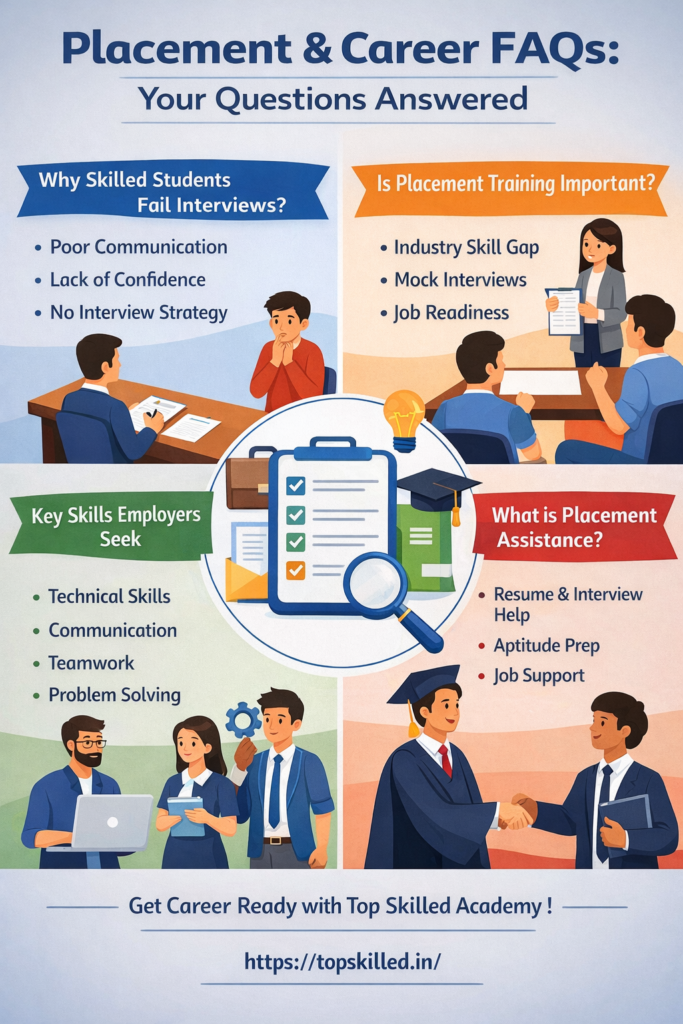
1) Why do skilled students fail interviews?
Many skilled students fail interviews not because they lack technical knowledge, but because they struggle with communication, confidence, and clarity. During interviews, companies assess how well a candidate explains concepts, presents projects, and handles real-time questions. Even if a student knows the correct answer, poor articulation or nervous body language can create a negative impression. Interviewers look for structured responses, logical thinking, and professional presentation. Technical skills alone are not enough candidates must demonstrate how they apply those skills in practical situations. Confidence, clarity of thought, and effective communication play a major role in selection. Without proper interview preparation and mock practice, even capable students may miss opportunities.
2) Is placement training really necessary?
Yes, placement training is highly necessary because there is often a gap between academic learning and industry expectations. Colleges mainly focus on syllabus completion and exams, while companies evaluate practical knowledge, communication skills, and problem-solving ability. Placement training bridges this gap by preparing students for real-world interviews. It includes resume building, mock interviews, aptitude preparation, and personality development. Through structured interview practice and feedback, students understand their weaknesses and improve gradually. Placement-focused training helps candidates become job-ready rather than just academically qualified. Without this structured preparation, many students feel unprepared and underconfident during actual recruitment drives.
3) What skills do companies look for in freshers?
Companies look for a balanced combination of technical knowledge and professional skills in freshers. Technical knowledge ensures that the candidate understands core concepts and tools related to their field. Communication skills are equally important, as employees must explain ideas clearly and collaborate effectively. Teamwork is essential because most companies operate in team-based environments where cooperation and adaptability matter. Problem-solving ability is another key factor, as organizations prefer candidates who can think logically and handle challenges independently. Beyond these, companies also value positive attitude, willingness to learn, and professional behavior. Freshers who develop both technical and soft skills significantly improve their chances of getting placed.
4) Do marks matter in campus placements?
Marks do matter in campus placements, but they are not the only deciding factor. Many companies use academic scores as an initial screening criterion to shortlist candidates. However, once shortlisted, selection depends more on technical skills, communication, confidence, and overall personality. A student with average marks but strong practical knowledge and interview performance can outperform a high scorer who lacks clarity and presentation skills. Employers today focus on job readiness, adaptability, and real-world understanding. While maintaining decent academic performance is important, students should also invest time in skill development, projects, and interview preparation to increase their placement opportunities.
5) How can students improve interview confidence?
Students can improve interview confidence through consistent practice and structured mock interview sessions. Confidence develops when candidates repeatedly explain their projects, answer common HR questions, and practice technical problem-solving under guidance. Mock interviews help simulate real interview conditions and reduce anxiety. Receiving feedback from mentors allows students to correct mistakes in communication, body language, and content clarity. Preparing a strong self-introduction and practicing commonly asked questions also builds self-assurance. Additionally, improving presentation skills and maintaining positive body language can significantly enhance confidence levels. Regular preparation and guided training transform nervous candidates into confident professionals ready for placement interviews.
6) What is the difference between skills and employability?
Skills refer to the technical abilities a student learns, such as programming, designing, or using specific tools. Employability, however, goes beyond technical knowledge. It includes communication skills, professional attitude, teamwork, adaptability, and interview readiness. A student may possess strong technical skills but still struggle to get placed due to poor communication or lack of confidence. Employability combines technical competence with soft skills and workplace behavior. Companies hire candidates who can contribute effectively in a professional environment, not just those who know concepts. Therefore, developing employability skills is essential for converting knowledge into real job opportunities.
7) How important are real-time projects in placements?
Real-time projects play a crucial role in placements because they demonstrate practical understanding. Recruiters often ask candidates to explain projects in detail, including challenges faced and solutions implemented. Working on real-time projects helps students apply theoretical concepts to real-world scenarios. It also improves problem-solving ability and builds confidence during interviews. Candidates who have hands-on experience can explain their work clearly and convincingly, making a stronger impression. Practical exposure through projects shows employers that the student is industry-ready and capable of handling tasks independently. Therefore, real-time project experience significantly increases placement success rates.
8) What is placement assistance?
Placement assistance is a structured support system designed to help students secure job opportunities. It includes resume preparation, interview training, aptitude practice, communication development, and job referrals. Placement assistance programs guide students through every stage of the recruitment process. They also provide mock interviews and feedback to improve performance. Unlike regular academic training, placement assistance focuses on making students job-ready and confident. It bridges the gap between learning and employment by offering practical preparation aligned with industry expectations. Effective placement assistance increases the chances of students getting selected during campus or off-campus drives.
